Posts

Showing posts with the label groundwater

Spain Is Thirsty. Here’s How It Gets Water

By Stanley Reed  and Rachel Chaundler , The New York Times.  Excerpt: ...tourists filled the cafes and hotel rooms along Spain’s Mediterranean coast, including in Torrevieja, a small city of tightly stacked apartment blocks running along a curved beach. ...low-slung structures house a vast network of pipes, pumps and tanks in a plant that performs a kind of alchemy crucial to the economy of this part of Spain: drawing huge volumes of water from the sea, removing the salt and creating more than 60 million gallons of fresh water a day. Acciona, a Spanish company that built the plant, says the facility can supply water for 1.6 million people through the process known as desalination. For much of the year, though, the output is largely used to nurture oranges, lemons and other crops for consumers in Northern Europe. The Torrevieja plant is the largest of its kind in Europe, and similar plants dot the Spanish coastline. ...With nearly 100 big plants, Spain is the largest user ...
Mexico City Has Long Thirsted for Water. The Crisis Is Worsening

By James Wagner ,  Emiliano Rodríguez Mega  and  Somini Sengupta , The New York Times.  Excerpt: A system of dams and canals may soon be unable to provide water to one of the world’s largest cities, a confluence of unchecked growth, crumbling infrastructure and a changing climate. The groundwater is quickly vanishing. A key reservoir got so low that it is no longer used to supply water. Last year was Mexico’s hottest and driest in at least 70 years. And one of the city’s main water systems faces a potential “Day Zero” this summer when levels dip so much that it, too, will no longer provide water. ...Mexico City, once a water-rich valley that was  drained  to make way for a vast city, has a metropolitan population of  23 million , among the  top 10  largest in the world and up from 15 million in 1990. It is one of several major cities facing severe water shortages, including  Cape Town ;  São Paulo , Brazil; and  Chennai , India...

How One of the Nation’s Fastest Growing Counties Plans to Find Water in the Desert

https://insideclimatenews.org/news/10022024/how-one-of-the-nations-fastest-growing-counties-plans-to-find-water-in-the-desert/ By David Condos, KUER (NPR Utah).  Excerpt: Like many places across the West, two things are on a collision course in Utah’s southwest corner: growth and water. Washington County’s population has  quadrupled  since 1990. St. George, its largest city, has been the  fastest-growing  metro area in the nation in recent years. ...The region has essentially  tapped out  the Colorado River tributary it depends on now, the Virgin River. ...The district’s 20-year plan comes down to two big ideas: reusing and conserving the water it already has.... 

‘Monster Fracks’ Are Getting Far Bigger. And Far Thirstier

https://www.nytimes.com/interactive/2023/09/25/climate/fracking-oil-gas-wells-water.html By Hiroko Tabuchi  and  Blacki Migliozzi , The New York Times. Excerpt: Giant new oil and gas wells that require astonishing volumes of water to fracture bedrock are threatening America’s fragile aquifers. ...energy giants are drilling not just for oil, but for the water they need. ...Along a parched stretch of La Salle County, Texas, workers last year dug some 700 feet deep into the ground, seeking freshwater. Millions of gallons of it. The water wouldn’t supply homes or irrigate farms. It was being used by the petroleum giant BP to frack for fossil fuels. The water would be mixed with sand and toxic chemicals and pumped right back underground — forcing oil and gas from the bedrock. ...Fracking a single oil or gas well can now use as much as 40 million gallons of water or more. These mega fracking projects, called “monster fracks” by researchers, have become the industry norm. They barely...

Cultural water and Indigenous water science

https://www.science.org/doi/10.1126/science.adi0658 By Erin O'Donnell et al, Science.  Excerpt: Water management failings in [Australia’s Murray-Darling Basin] MDB, which is home to more than 40 First Nations who have lived sustainably with water for tens of thousands of years through the creation and application of Indigenous water science ..., have drawn attention to the living legacies of colonial exploitation and the associated social and ecological impacts. We need to learn from Australia’s failures and change the way we know, value, and manage water, including learning from Indigenous scientists and Elders. The MDB, which supports a center of irrigated agriculture across more than 1 million km 2 , is known for its multiyear “boom-bust” riverine cycles, but climate change is intensifying these extremes. ...When the British invaded Australia, the legitimacy of their occupation was founded on the assumption of terra nullius, or land belonging to no one, despite the clear presenc...

On the Afghanistan-Iran border, climate change fuels a fight over water

https://www.science.org/content/article/afghanistan-iran-border-climate-change-fuels-fight-over-water By Ruchi Kumar, Science.  Excerpt: Fueled in part by a prolonged drought, tensions over water between Iran and Afghanistan have escalated this year, with Iran accusing Taliban leaders of violating a long-standing agreement to share water from the Helmand River that flows from Afghanistan into Iran. In late May, clashes near the river reportedly led to the deaths of at least two Iranian border guards and one Taliban fighter. Climate change could only worsen the conflict, researchers say. Although detailed data are scarce,  a recent study concluded  that average temperatures in Afghanistan have risen by between 0.6°C and 1.8°C since 1950. And, “If you look at the map [of Afghanistan], the area that has the highest change in temperatures [is] … where the conflict has occurred,” says water specialist Assem Mayar, a former lecturer at Kabul Polytechnic University.... 

Colorado River snaking through Grand Canyon most endangered US waterway – report

https://www.theguardian.com/us-news/2023/apr/17/colorado-river-grand-canyon-climate-crisis-endangered By Nina Lakhani . The Guardian.  Excerpt: A 277-mile stretch of the  Colorado  River that snakes through the iconic Grand Canyon is America’s most endangered waterway, a new report has found. The unique ecosystem and cultural heritage of the Grand Canyon is on the brink of collapse due to prolonged drought, rising temperatures and outdated river management, according to American Rivers, the conservation group that compiles  the annual endangered list. ...The 2023 list includes rivers that traverse 17 states and scores of sovereign tribal nations, and supply drinking water, food, recreation and spiritual nourishment to millions of people. The waterways are under threat from mining, the climate breakdown, dams, industrial pollution and outdated river management practices that for too long have rebuffed traditional knowledge and sustainable techniques tried and tested ...

Global fresh water demand will outstrip supply by 40% by 2030, say experts

https://www.theguardian.com/environment/2023/mar/17/global-fresh-water-demand-outstrip-supply-by-2030 By Fiona Harvey , The Guardian.  Excerpt: The world is facing an imminent  water crisis , with demand expected to outstrip the supply of fresh water by 40% by the end of this decade, experts have said on the eve of a crucial UN water summit. Governments must urgently stop subsidising the extraction and overuse of water through misdirected agricultural subsidies, and industries from mining to manufacturing must be made to overhaul their wasteful practices, according to  a landmark report  on the economics of water. ...Many governments still do not realise  how interdependent they are when it comes to water , according to Rockstrom. Most countries depend for about half of their water supply on the evaporation of water from neighbouring countries – known as “green” water because it is held in soils and delivered from transpiration in forests and other ecosystems, w...

Skipped Showers, Paper Plates: An Arizona Suburb’s Water Is Cut Off

https://www.nytimes.com/2023/01/16/us/arizona-water-rio-verde-scottsdale.html By  Jack Healy , The New York Times.  Excerpt: RIO VERDE, Ariz. — Joe McCue thought he had found a desert paradise when he bought one of the new stucco houses sprouting in the granite foothills of Rio Verde, Ariz. There were good schools, mountain views and cactus-spangled hiking trails out the back door. Then the water got cut off. Earlier this month, the community’s longtime water supplier, the neighboring city of Scottsdale, turned off the tap for Rio Verde Foothills, blaming a grinding drought that is threatening the future of the West. Scottsdale said it had to focus on conserving water for its own residents, and  could no longer sell water  to roughly 500 to 700 homes — or around 1,000 people. ...Almost overnight, the Rio Verde Foothills turned into a worst-case scenario of a hotter, drier climate, showing what happens when unregulated growth collides with shrinking water supplies.......

Thousands Will Live Here One Day (as Long as They Can Find Water)

https://www.nytimes.com/2022/12/27/business/water-development-west.html By  Keith Schneider , The New York Times.  Excerpt: ...The development, Teravalis, is expected to have 100,000 homes and 55 million square feet of commercial space. But to make it happen, the project’s developer, the Howard Hughes Corporation, will need to gain access to enough water for its projected 300,000 residents and 450,000 workers. Teravalis is seen by local and state leaders as a crowning achievement in a booming real estate market, but it also represents the intensifying challenge in Arizona and other fast-growing Southwestern states: to build huge mixed-use projects in an era of water scarcity. ...Persistent dry conditions are driving up the cost of water and prompting more resistance to new development. But the scarcity of water is also pushing developers to innovate with design and install expensive infrastructure to save fresh water and recycle more wastewater. ...In Arizona, groundwater leve...

Not Your Childhood Water Cycle

Image
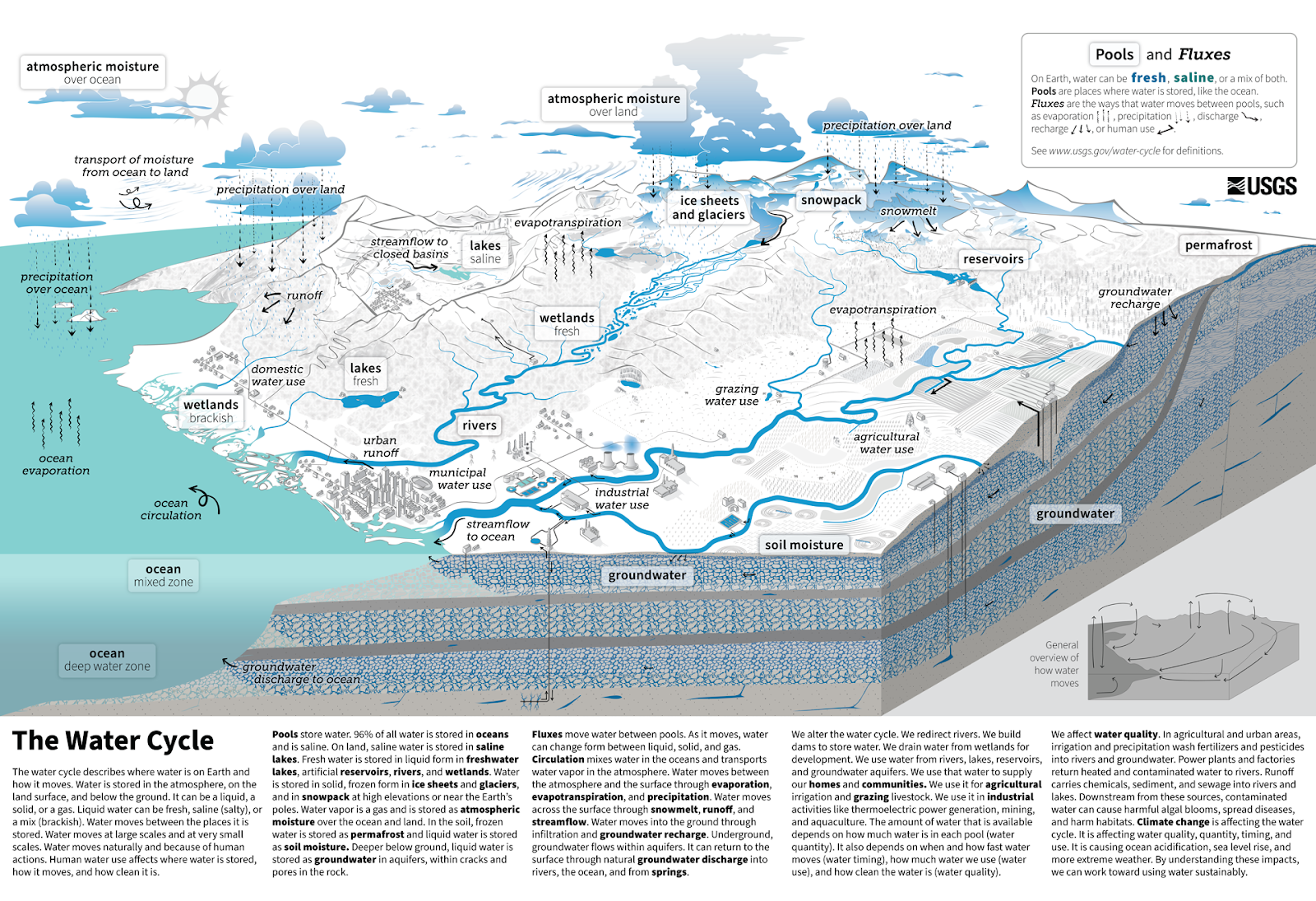
https://eos.org/articles/not-your-childhood-water-cycle By  Jenessa Duncombe , Eos/AGU.  Excerpt:  The USGS just debuted a complete remaking of the water cycle diagram—with humans as headliners.  ...The U.S. Geological Survey (USGS) water cycle diagram is still used by hundreds of thousands of students in the United States and worldwide. It’s also the basis for many, many spin-off diagrams. Today, the agency released a  new diagram  for the first time in more than 20 years, this time with humans as showrunners. Although people have long siphoned water from groundwater and diverted rivers into farm fields and industrial plants, the new diagram is the first time humans have been included in what was presented until now as a “natural” cycle. The change reflects the latest 20 years of research uncovering humanity’s central role in the cycle and how to communicate it visually.… 

Satellite images reveal shrinkage of Utah’s Great Salt Lake

https://www.theguardian.com/environment/2022/aug/02/satellite-images-reveal-shrinkage-of-utahs-great-salt-lake By  Sadia Nowshin , The Guardian.  Excerpt: Striking new images show lake has lost nearly half of its surface area from the historical average. ...The disappearance of the lake has been attributed to drought caused by climate breakdown and water use, along with the redirection of water from streams used to replenish the lake for use in residential spaces and agriculture. The demand for the lake’s water has increased as the population of Utah climbs. Currently home to about 3.3 million people, it is projected that the population will  increase by 66% by 2060 , making it the fastest growing state in the US.… [Note: this article has a great interactive graphic comparing the Great Salt Lake in 1985 and 2022.] 

As Water Runs Low, San Joaquin Valley Adapts to a Drier Future

https://alumni.berkeley.edu/california-magazine/winter-2021/water-runs-low-san-joaquin-valley-adapts-drier-future By Glen Martin, California Magazine.  Excerpt: As the drought has deepened in the state, growers have turned to groundwater, resulting in severe overdraft in many areas—particularly the San Joaquin Valley. That led to the passage of the 2014 Sustainable Groundwater Management Act (SGMA), which required the identification of the state’s overdrawn and at-risk basins, quantification of their yields, and the development of pumping plans that achieve sustainability within 20 years of being implemented. ...Almond trees are only commercially productive for about 20 years, and his groundwater plan means replacement trees won’t be planted in many areas. Instead, Woolf will concentrate on growing tomatoes for processing, as well as pistachios, which are longer-lived and less thirsty than almonds. ...Woolf is also experimenting with alternative crops—specifically, drough...

Iran Forcefully Clamps Down on Protests Against Growing Water Shortages

https://www.nytimes.com/2021/11/26/world/middleeast/iran-protests-water-shortages.html By  Farnaz Fassihi , The New York Times.  Excerpt: ...Weather experts say 97 percent of the country is dealing with water scarcity issues....Experts on Iran’s water scarcity issues say climate change and reduced rainfall have exacerbated the drought caused by mismanagement.…

The Colorado River is shrinking. Hard choices lie ahead, this scientist warns

https://www.sciencemag.org/news/2021/07/colorado-river-shrinking-hard-choices-lie-ahead-scientist-warns Source: By  Erik Stokstad , Science Magazine.  Excerpt: ...As a warming climate reduces the river’s flow, ...public debate over water resources ...is too often clouded by wishful or outdated thinking. The biggest delusion: that there will be enough water in a drier future to satisfy all the demands from cities, farmers, power producers, and others, while still protecting sensitive ecosystems and endangered species. The hard truth, according to long-term scenarios produced by Schmidt and his colleagues, is that some users will have to consume less water, and that policymakers will face agonizing choices sure to produce winners and losers. Those are messages that many players aren’t eager to hear, especially states planning to drain more water from the river to fuel growth. But Schmidt says he and his colleagues simply want everyone to understand the potentially divisive trade...

Groundwater Crisis in Zimbabwe Brought On by Droughts

https://eos.org/articles/groundwater-crisis-in-zimbabwe-brought-on-by-droughts Source:  By Andrew Mambondiyani, Eos/AGU.  Excerpt: Zimbabwe’s groundwater is disappearing fast, leaving rural communities without water for household and agricultural use. In parched Zimbabwe, farmers—along with water experts and policy makers—are apprehensive as groundwater is depleted rapidly because of drawn-out droughts. ... Anna Brazier , an independent climate change researcher and consultant based in Zimbabwe, said that although drought years are part of the normal climate cycle in this part of Africa—often associated with the well-known El Niño–Southern Oscillation— global warming is causing droughts to become more frequent , more intense, and less predictable. ...“Strategic use of groundwater for food security in a changing climate is becoming more and more important. It is important for farmers to utilize water resources sustainably to allow water seepage to greater depths,” Zhakata sai...

The Merchants of Thirst

https://www.nytimes.com/2020/01/11/business/drought-increasing-worldwide.html Source:  By Peter Schwartzstein, The New York Times. Excerpt: In Kathmandu, as in much of South Asia and parts of the Middle East, South America and sub-Saharan Africa, these men and their tanker trucks sometimes prevent entire cities from running dry. Without them, millions of households wouldn’t have sufficient water to cook, clean or wash. Or perhaps any at all. And without them, an already deteriorating infrastructure might break down completely, as the tanker men know well. ...Yet there’s another side to them, too, one that is less pleasant and sometimes outright nasty. Tankers frequently deliver poor quality water, which can sicken. They usually charge much more than the state, devastating to the poor. ...But the tanker industry might also be an early illustration of how parts of the private sector stand to profit from a warming and fast-urbanizing world. The urban population of South Asia alone...

Modeling How Groundwater Pumping Will Affect Aquatic Ecosystems

https://eos.org/articles/modeling-how-groundwater-pumping-will-affect-aquatic-ecosystems Source:   By Adityarup Chakravorty, Eos/AGU. Excerpt: Almost 30% of Earth’s freshwater supply lies hidden from view as groundwater. These waters, though mostly invisible, are vital for us humans. Groundwater provides about half the global supply of drinking water and is used to grow the majority of the world’s irrigated crops. Groundwater is also an inextricable cog in the global water cycle. In many areas, discharge from groundwater replenishes streams and rivers, helping sustain aquatic ecosystems. Many of these ecosystems are now under threat, according to a new study. Inge de Graaf, a hydrological environmental systems researcher at the University of Freiburg, and colleagues simulated on a global scale how current rates of groundwater extraction will affect surface streams and rivers and the ecosystems associated with them. “Almost 20% of the regions where groundwater is pumped currentl...